Curtains are the biggest interior design trend of 2025. Here’s why
Arriving at the Ra Ra Room, a members-only supper club in Phoenix, Arizona, is a bit like a treasure hunt. Guests enter through a back door of a sports arena and walk past the loading dock before trekking down a long corridor until reaching a martini glass–shaped neon sign. After opening a heavy red door, they enter a space dripping in art deco opulence – cascading glass chandeliers, a champagne-hued ceiling, plush leopard-print banquettes and walls covered in lustrous draperies. Some are ruched, with scalloped folds like a stage curtain, while others shimmer, like gold lamé.
‘The drapes are almost like a garment,’ says Siobhan Barry, a design director at Gensler, the architecture firm that designed the club. ‘They are this layer of glamour that levels up the space to fantasy.’

The glamorous, art deco-inspired interiors in Ra Ra Room.
(Image credit: Douglas Friedman)
Across interiors, curtains – yes, curtains – are having a moment. They’ve shed their reputation as stuffy and outdated dust catchers and have been liberated from the area immediately around windows to cover entire walls. To wit: The bar at People’s, the private social club in Manhattan’s Greenwich Village, is cloaked in ethereal and romantic pale yellow drapes. Crimson curtains adorn the walls of The Nines, a piano bar in NoHo. At WSA, the Financial District office tower that creative director Gabriella Khalil has transformed into a scene-y creative hub, rich brown drapery lines the corridors while eggshell curtains envelop the lounge. Then there’s Valentino’s new monochromatic listening room at its Madison Avenue boutique, which is (you guessed it) surrounded by curtains. Meanwhile, the Theatre District hotel Civilian features a curtained accent wall with artwork hung in front of the fabric.
But how did this happen? Why, all of a sudden, are rooms swaddled in endless yards of fabric? These spaces are textured and beautiful, and speak to a number of trends that are shaping interiors today, including fashion and maximalism, but also reveal subconscious associations with comfort, privacy, performance and exclusivity – the factors people are craving in the spaces they enter right now.

Napoleon’s curtain-covered bedroom was inspired by Roman war tents.
(Image credit: Getty Images)
Curtains, of course, are not new. But the context in which they appear is ever-shifting. In the late 18th and early-19th centuries, Napoleon I pitched fully furnished battlefield tents, inspired by ancient Roman war tents, during his military campaigns and brought this aesthetic to his Parisian chateaux. Decorators mimicked the look in their clients’ homes.
Fast forward to 1903 when the Viennese modernist Adolf Loos designed a bedroom for his wife Lina furnished with a white fur rug and bed frame and an almost armour-like perimeter of white drapes on all the walls. The Spanish architect and writer José Quetglas described the room as ‘an architecture of pleasure’ and ‘an architecture of the womb.’ Decades later, Billy Baldwin designed a tented room for editor and socialite Babe Paley’s apartment in the St. Regis Hotel and Halston, ahead of his minimalist Cocaine Decor era, wrapped his first showroom in groovy red, orange and white curtains.

An image from a 1903 magazine depicting Loos’s influential curtain-lined bedroom.
(Image credit: MAK – Museum of Applied Arts, Vienna)
Paley’s dramatic room, then the pinnacle of Upper East Side style, inspired the bar at People’s, which the firm Workstead designed. The designers wanted the social club’s interiors to feel ‘sartorial,’ according to Ryan Mahoney, Workstead’s creative director. ‘Covering an entire room with drapery can unify a space and offer a sense of mystery and playfulness,’ Mahoney says. In addition to creating a warm atmosphere – dialled up through a palette of mauve, tawny brown, pale yellow and olive green hues – the soft materials also help acoustically.
The sense of richness at People’s – as well as in restaurants, bars, clubs and hotels writ large – isn’t just for vibes; it reflects the competitive reality of business today. Proprietors have to create the just-right look for the guests they’d like to attract. ‘In a world where so much can be done from home, hospitality spaces have to draw people in,’ Mahoney says. ‘People are looking for memorable experiences.’

(Image credit: Matthew Williams)
And the just-right experience, too. Barry, of Gensler, notes that while upscale establishments want an aesthetic that matches, they still need to be comfortable. Too fancy and it runs the risk of feeling uptight (Think: 1980s Armani vs. a Saville Row three-piece suit). ‘If it’s buttoned up, tailored, and everything is perfect, then we feel like we have to behave accordingly,’ she says. To her, draped fabric has a more relaxed sensibility. ‘They’re beautiful and fancy, but not fussed over,’ she says. ‘They take the air out a little bit.’
‘They’re beautiful and fancy, but not fussed over.’
Siobhan Barry, Gensler
There’s actual science behind why draped fabric makes us feel this way, says Dr. Sally Augustin, an environmental psychologist. ‘We link curving lines in two and three dimensions to comfort and relaxation while straight lines are tied to efficiency action,’ Dr. Augustin says. So those loosely-hung swoops of fabric are soothing to our brain.
Augustin believes that current events are playing a role in why this motif is so ubiquitous. ‘There’s something going on in every continent that is causing people to be on edge,’ she says. ‘Environments with softer textures and colours give people an opportunity to recoup. They don’t make the bad thing go away, but at least you can become revitalized in them, to a certain extent.’

Booths at the Nines in Manhattan are clad in sumptuous red drapes.
(Image credit: Liz Clayman)
The psychological associations draperies carry has been an obsession for Monica Curiel, an artist and designer based in Colorado who creates paintings and sculptures that mimic softly draped fabric but are made from plaster and spackle. Works of hers appeared in the New York gallery Love House’s recent ‘Family Show’ exhibition and in ‘Outside/In,’ a recent show at Lyle Gallery. The works explore matrilineal kinship (plus the materials her father, who works in construction, uses). ‘Certain textiles – like doilies, crochet, and drapery – evoke nostalgia,’ Curiel says. ‘I often associate them with my mother’s home or my grandmother’s home. I learned how to sew with these women in my life. And so for me, there is also this sense of care, innocence and curiosity.’

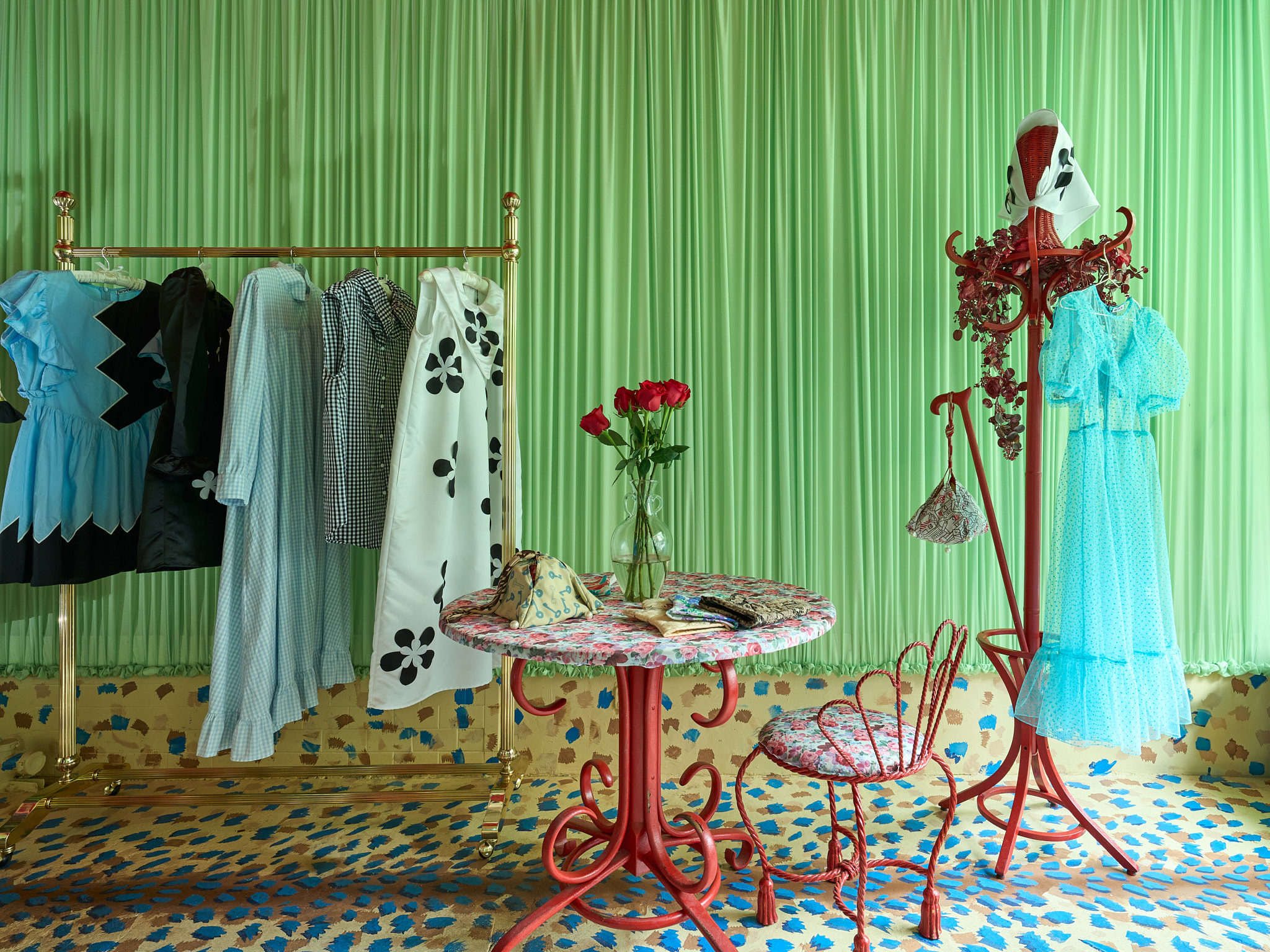
Batsheva’s New York boutique is draped in pistachio-green curtains.
(Image credit: Andre Herrero)
While curtains possess layers of emotional meaning, they also manipulate our perception of space. This is one of the reasons why Adam Charlap Hyman likes to cover walls with draperies in his firm’s projects, including a Miami Beach apartment, Rosetta Getty’s showroom and Batsheva’s SoHo boutique. ‘You end up with a wall that appears soft, as well as a device for privacy that suggests a space beyond,’ Charlap Hyman says, noting that Carlo Molino’s Casa Devalle is one of his favourite examples of a room with draperies as wall coverings. ‘This technique has the power to either clarify or subdue the form of a room; it can be conveniently deceptive if you’re looking to create barriers that don’t exist, and reversely, it allows legitimate walls to appear more impermanent.’
The use of draperies to mediate private and public has precedent in Loos’s work. The Viennese architect often covered windows in sheer curtains to protect the people inside the homes from the gaze of passersby. Additionally, he conceived of his interiors as stage sets for the theatre of daily life and, as the theorist Beatriz Colomina notes in her 1996 book ‘Privacy and Publicity,’ curtains ‘enhance’ this effect.
‘We’re seeing a strong desire for interiors that do more than decorate—they need to narrate, to ground to inspire.’
Rachel Cope, Calico
The association between curtains and performance is another reason why the motif is so alluring. In May, the British designer Lee Broom released a new wall covering collection with Calico named Overture that has a trompe l’oeil drapery effect. Broom, who was an actor as a child, has long been fascinated by how set designers were able to use simple materials like fabric and light to transform the stage. According to the designer, the wall covering takes those who experience it on an imaginative journey. ‘Drapery has a natural theatricality to it,’ he says. ‘It’s expressive, fluid, and full of suggestion.’
Rachel Cope, Calico’s creative director and co-founder, appreciates the sense of anticipation the wall covering evokes. It ‘embodies a cinematic stillness – like a breath held just before a curtain rises,’ she says. This emotive quality helps animate rooms. ‘We’re seeing a strong desire for interiors that do more than decorate – they need to narrate, to ground to inspire,’ Cope adds.

Lee Broom’s Overture wallcovering, created in collaboration with Calico.
(Image credit: William Jess Laird)
And of course social media, which has transformed cities into sets and people into directors and performers, can’t be ignored. When everyone wants to be the main character, spaces becoming more stagelike – literally – are perhaps a logical progression. These drapery-drenched interiors are ready to frame the scenes that appear on the five-inch screens we all carry.
‘There is the truth of Instagram culture,’ Barry says of the trend. ‘We are the photos we take of ourselves; we are the scene in which we are being seen.’
link
:max_bytes(150000):strip_icc()/GettyImages-1239959628-1992ec9ca1194bd082e13488a44a8916.jpg "5 Living Room Red Flags That Guests Immediately Notice, Designers Say")

:max_bytes(150000):strip_icc()/GettyImages-2196178842-b558c6c2141b4b8a87412d4860b78fcf.jpg "5 Secret Ways Designers Make a Room Smell Incredible")