Design-Build Requirements In North Carolina – Real Estate

Two Ward and Smith attorneys discussed essential design-build
requirements in North Carolina, as well as some of the key
advantages and disadvantages of this project delivery method.

The presentation featured insights from Alex Ferri, a litigation attorney who assists
construction industry clients with general litigation matters
throughout all phases of the process—from investigation and
pleading to trial, settlement, and appeal. Ferri is a licensed
North Carolina general contractor with years of experience in
construction.
Jason Strickland, a construction attorney who
represents contractors, subcontractors, owners, lenders, and design
professionals, also offered guidance. His experience includes
preparing and negotiating construction contracts, as well as
helping clients implement best practices for managing construction
projects.
Design-build requirements vary depending on the type of
owner—whether a state or local government entity, a federal
agency, or a private homeowner. Public owners typically decide on
the delivery method at a preliminary project stage.
“With private projects, it is common to see a mismatch
between what the parties want to do and what kind of delivery
method they choose,” noted Strickland. “We recently had a
situation where the client wanted design-bid-build contracts, but
what they were really doing was construction manager at
risk.”
In the traditional design-bid-build and construction manager at
risk system, the designer is working for the owner. Issues with the
design would therefore be the responsibility of the owner.
“The key thing distinguishing design build is that the
designer is working for the general contractor, so risk associated
with design are shifted to the contractor or the
design-builder,” added Strickland.
The design-build delivery system can be beneficial for all
parties involved. Owners typically prefer design-build because it
places design responsibilities on the contractor. Contractors tend
to prefer design-build because it reduces friction between them and
the designer.
Public Project Requirements in Design-Build
The design-build delivery method for North Carolina state and
local public projects is governed by North Carolina General Statute
143-128.1A. This statute requires any governmental entity using
design-build to establish, in writing, the criteria for determining
whether this method is appropriate.
The rules apply to all government entities working on behalf of
the state of North Carolina, such as municipalities, departments,
or commissions. “Local projects may have additional
rules,” Ferri said, “so the takeaway is this sets a floor
for public projects statewide.”
The written criteria for determining whether design-build is
appropriate include:
- The extent to which the project requirements can be defined
before the issuance of a Request for Qualifications from a
design‑builder; - Time constraints for project delivery;
- Ability to ensure that a quality project can be delivered;
- The capability of the governmental entity to manage the
project, including the availability of staff or outside consultants
with experience in design‑build; - Good-faith effort to comply with applicable statutes and to
work with small, properly licensed small or minority businesses;
and - Other criteria used by the governmental entity to compare
design‑build to other delivery methods.
Understanding the Bidding Process in Design-Build
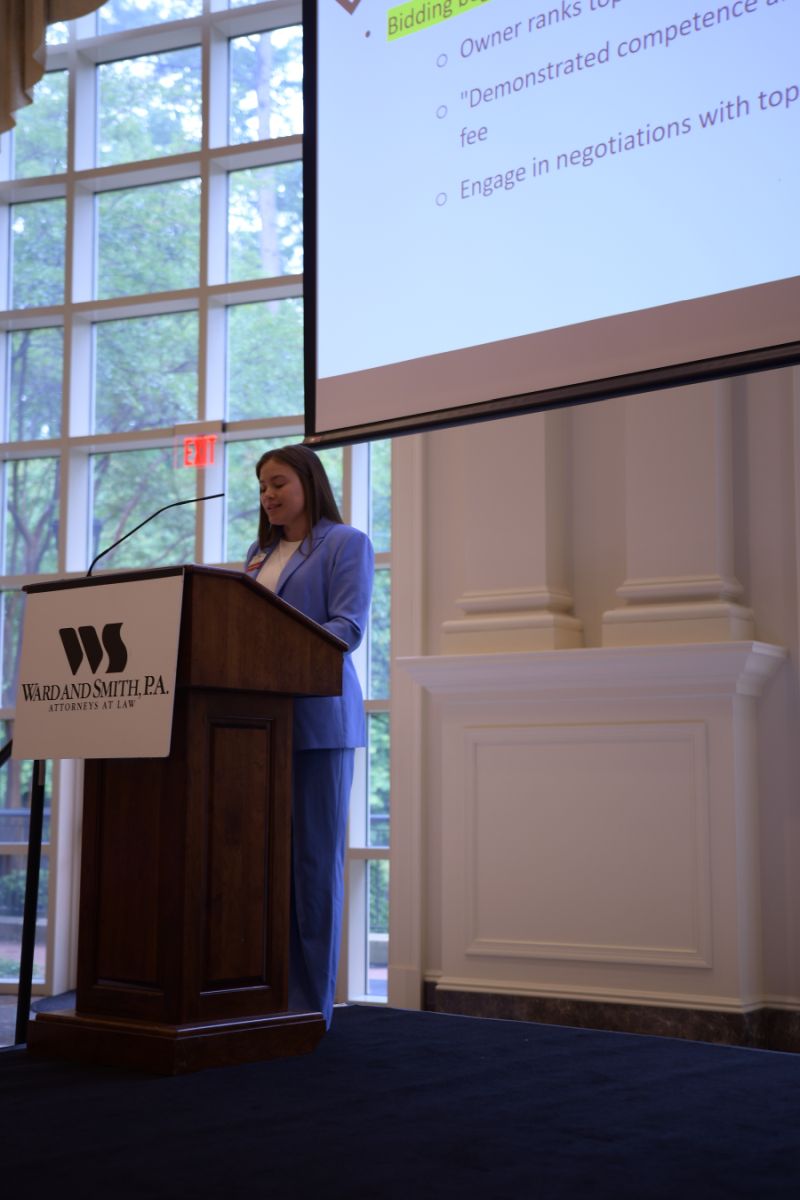
Once it has been determined that design-build is appropriate,
the solicitation of bids starts with a public issuance of the
Request for Qualifications. “The most important items to
include are the project site, the project scope, and the
anticipated budget,” Ferri commented.
The governmental owner will also outline a variety of additional
factors that will be considered when comparing each bid, along with
the weight that will be given to each factor. Examples could
include the size of the business and whether it is minority
owned.
An explanation of the project team is another requirement.
“Once the bids are in, the owner ranks the top three most
highly qualified bidders,” added Ferri. “If there are
fewer than three responses, the owner has to make a new
solicitation. If this doesn’t bring more bidders, the owner
starts negotiating with the most highly ranked bidder.”
Evaluating the competency of a bidder involves assessing prior
work, professional qualifications, and specialized experience.
“Owners are encouraged to ask bidders about the concepts and
approaches they will apply to the new project,” Ferri said,
“but it’s important to know that the owner cannot solicit
or consider work product or designs for the proposed
project.”
Design-Build Methodology
The owner will choose a project team selection option for the
design-builder to follow when selecting its team.
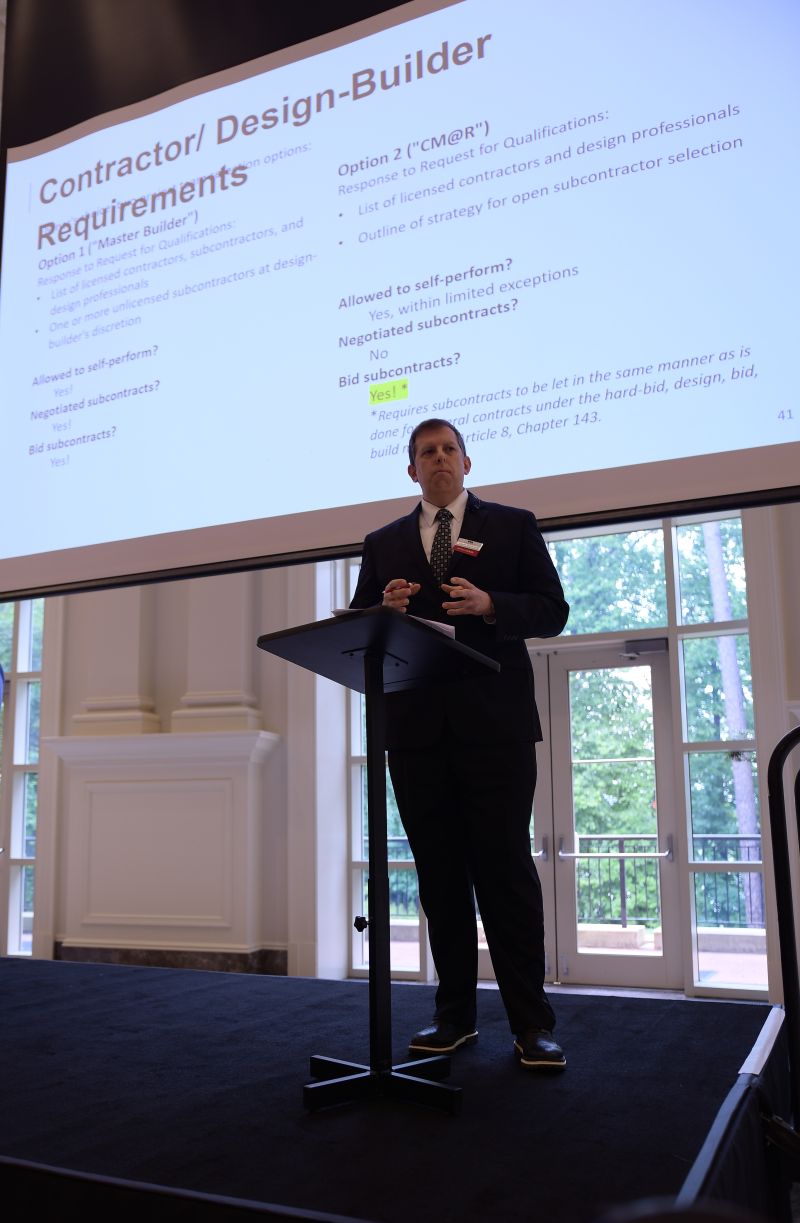
With the Master Builder option, the response to the Request for
Qualifications would include:
- List of licensed contractors, subcontractors, and design
professionals - One or more unlicensed subcontractors at design-builder’s
discretion
“Under the master builder method, there’s a lot more
flexibility for the design builder to both self-perform and
negotiate subcontracts,” Strickland explained.
The second option is similar to the Construction Manager at Risk
method. If this option is chosen, the response to the Request for
Qualifications would include:
- List of licensed contractors and design professionals
- Outline of strategy for open subcontractor selection
“In this scenario, the design builder is required to bid
out after pre-qualification and can only self-perform work under
very limited exceptions,” noted Strickland. Subcontracts are
required to be included in the project in the same manner as
general contracts under the hard-bid, design, bid, and build
method, as outlined in Article 8, Chapter 143.
General contractors engaged in the design-build delivery method
should make sure their preliminary design work does not run afoul
of the architecture licensing laws. Notably, a general contractor
may not use an in-house architect for the design portion unless the
general contractor is also a licensed architect. A few alternatives
that owners should potentially consider include contracting with a
general contractor, who then contracts with an architect, or
contracting with a firm that is a licensed general contractor as
well as an architect.
Federal Design-Build Projects
“With federal projects, design build is not as
comprehensively controlled as it is with projects in North
Carolina,” commented Strickland. However, the requirements for
determining if a two-phase selection process will be necessary are
fairly complex. Generally, the owner/contractor officer must
consider the following criteria:
- Whether three or more bids will be received
- If design work is necessary before an offeror can develop a
cost proposal - Whether creating the offer will require a substantial amount of
expense - Other criteria (a ‘catch-all’ category)
“The goal appears to be to restrict the use of design-build
to situations where it is both appropriate and necessary,”
Strickland explained.
The specific agency in charge of the project will develop a
scope of work statement to include in the solicitation. This will
define the project and provide specific requirements for the
project, such as preliminary design, budget parameters, and
schedule for delivery requirements.
The contracting officer will ask for proposals with background
information on the offeror’s technical approach and
qualifications. The offer should not include information on
detailed design, cost, or price.
The agency then evaluates the offers, considering factors such
as specialized experience, technical competence, capabilities, and
past performance. The agency typically then selects the top five
offers to move forward into phase two.
At this point, the top five offerors submit phase two
competitive proposals that include technical information, design
concepts, proposed solutions, and projections for cost and price.
“Cost and price are where we veer away from how North Carolina
functions,” noted Ferri.
The federal government has an endless array of agencies, and
there are notable similarities to local governments in North
Carolina, said Ferri: “The federal government makes the rules,
but each agency may have a different interpretation of those rules.
The takeaway is that the bidding process could vary from agency to
agency.”
Private Design-Build Projects
In North Carolina, there is no statute for private projects that
mandates the specific steps for design-build. The result is a more
flexible process, where the owners, contractors, and subcontractors
outline the terms and requirements in the contract.
“The intent is to remove some of the friction points that
would otherwise impede the use of the design-build project delivery
method,” added Strickland. “This does not eliminate
licensing requirements. You still have to be properly licensed. One
of the main ways people get into trouble is for doing construction
without a license.”
Standard contract forms are often used, and the most common is
from the Design-Build Institute of America (DBIA). “Because
there’s not a statute controlling the process, these standard
contract forms are very important,” commented Strickland.
DBIA forms contemplate the design work being performed and the
bulk of the construction work that is being subcontracted. The
forms can be adapted to the project, so it may be possible to see
them on public projects.
The second most commonly used form is from the American
Institute of Architects (AIA). As may be expected given the name,
these forms favor contractors and especially designers; DBIA forms
are more balanced.
“It is vital to negotiate a fair contract with specific
provisions you understand, and to avoid something that requires you
to assume more risk than necessary. We often see situations where
the terms of the deal are basically done, and then the other
party’s attorney changes a host of provisions to favor their
client at the last minute. So, I would encourage you to carefully
review everything and don’t just assume that the contract is
only based on the terms you’ve discussed,” advised
Strickland.
Questions About Design-Build Contracts and Compliance
An audience member wondered if it would be appropriate to
respond to a federal owner with a Request for Qualification,
including design and cost, if that owner had not specified that
there should be two phases.
The best advice is to follow the rules of the statute. If the
owner asks for a price, mention that pricing will not be provided
until phase two and/or ask a clarifying question concerning whether
the quote should be based on the unit price.
In regard to self-performing work under the master-builder
method, it would be permissible to use unlicensed subcontractors.
“If it’s work that requires a license, however, such as
electrical work, you will still have to have a license,”
concluded Strickland.
For permission to reprint articles, please contact the [email protected] Marketing Department.
© 2025 Blake, Cassels & Graydon LLP.
The content of this article is intended to provide a general
guide to the subject matter. Specialist advice should be sought
about your specific circumstances.
link